
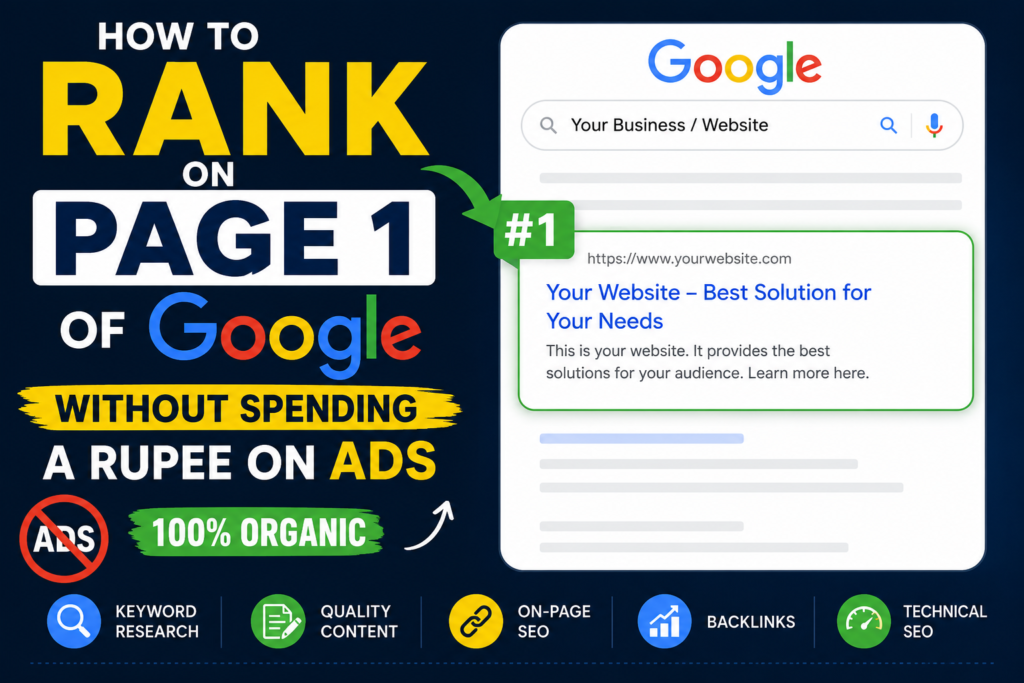
Every business owner dreams of appearing on page 1 of Google — but most assume it requires a massive advertising budget. The truth? You absolutely can rank on page 1 of Google without spending a single rupee on paid ads. It just takes the right strategy, consistency, and a clear understanding of how Google’s algorithm works.
In this guide, I’ll walk you through the exact free SEO strategies I use to help clients achieve top Google rankings organically. Whether you’re a small business owner, a startup founder, or someone managing your own brand, these actionable tips will help you improve your Google ranking — no ad spend required.
What Does It Really Mean to Rank on Page 1 of Google?
When someone searches for a product, service, or information on Google, they rarely go beyond the first page of results. In fact, studies show that over 75% of users never scroll past page 1. This means that if your website isn’t ranking in those top 10 positions, you’re essentially invisible to the majority of your potential customers.
Ranking on page 1 organically (without paying for ads) is achieved through Search Engine Optimisation — or SEO. It involves optimising your website’s content, structure, and authority so that Google considers it the most relevant and trustworthy result for a given search query.
Step 1: Start with Smart Keyword Research
The foundation of every successful SEO strategy is choosing the right keywords. You want to target search terms that your ideal customers are actually typing into Google — and that you have a realistic chance of ranking for.
Free keyword research tools to use:
• Google Search Console — shows what queries already bring users to your site
• Google Keyword Planner — free inside Google Ads (no spend required to use it)
• Ubersuggest Free Plan — keyword ideas and difficulty scores
• AnswerThePublic — discover questions people are searching around your topic
Pro tip: Focus on long-tail keywords — phrases with 3 to 5 words that are more specific and less competitive. For example, instead of targeting “digital marketing” (extremely competitive), target “affordable digital marketing for restaurants in Kochi” (much easier to rank for). Long-tail keywords are your fastest path to Google ranking without ads.
Step 2: Master On-Page SEO
On-page SEO refers to all the optimisations you make directly on your website pages. This is one of the most powerful free SEO strategies available, and it’s completely within your control. Getting on-page SEO right signals to Google exactly what your page is about — helping you rank without ads.
Key On-Page SEO Elements:
1. Title Tag — Include your primary keyword near the beginning. Keep it under 60 characters.
2. Meta Description — Write a compelling 150-160 character summary with your keyword naturally included.
3. H1 and H2 Headings — Your H1 should contain the primary keyword; use H2s for secondary keywords.
4. URL Structure — Keep URLs short and keyword-rich (e.g., /rank-on-page-1-google).
5. Image Alt Text — Describe every image with relevant keywords; Google can’t ‘see’ images, only read text.
6. Internal Links — Link to other relevant pages on your site to help Google understand your content structure.
Step 3: Create Content That Google Loves
Content is the single most important factor in your ability to rank on page 1 of Google for free. Google’s algorithm prioritises content that is helpful, accurate, comprehensive, and written for humans — not just stuffed with keywords.
This is what Google’s E-E-A-T framework stands for: Experience, Expertise, Authoritativeness, and Trustworthiness. The more your content demonstrates these qualities, the better your chances of achieving top organic rankings.
Content best practices to improve your Google ranking:
• Write long-form content of 1,500 words or more — longer posts tend to rank higher for competitive keywords
• Answer the exact question your target keyword asks — match search intent precisely
• Use your primary keyword in the first 100 words naturally
• Incorporate secondary keywords throughout without forcing them
• Update older blog posts regularly — Google favours fresh, current content
Step 4: Build Authority With Backlinks (For Free)
Backlinks — links from other websites pointing to yours — are one of Google’s most important ranking signals. The more reputable sites link to your content, the more authoritative Google considers your website to be. And while many people pay for backlinks, there are proven free ways to earn them.
Free backlink-building strategies:
• Guest Posting — Write articles for reputable blogs in your industry and include a link back to your site
• HARO (Help a Reporter Out) — Respond to journalist queries and get cited with a link in media articles
• Business Directories — List your business on Google My Business, Justdial, Sulekha, and other Indian directories
• Broken Link Building — Find broken links on other websites and offer your content as a replacement
• Social Sharing — While social links aren’t direct ranking signals, viral content attracts natural backlinks
Step 5: Optimise Your Website’s Technical SEO
Even the best content won’t rank if your website has technical issues that prevent Google from properly crawling and indexing it. Technical SEO ensures Google can find, understand, and rank your pages effectively — and most technical fixes are free to implement.
Critical technical SEO checklist:
• Page Speed — Google prioritises fast-loading pages; use Google PageSpeed Insights (free) to identify and fix speed issues
• Mobile-Friendliness — Over 60% of searches in India happen on mobile; your site must be fully responsive
• HTTPS Security — Google treats non-HTTPS sites as unsafe; ensure your SSL certificate is active
• XML Sitemap — Submit a sitemap to Google Search Console so Google knows all pages to index
• Core Web Vitals — Monitor LCP, FID, and CLS scores using Google’s free tools for better rankings
Step 6: Leverage Google My Business for Local SEO
If you run a local business, Google My Business (now called Google Business Profile) is your most powerful free tool to rank on page 1 locally. A fully optimised profile can place you in the coveted ‘Local Pack’ — the three businesses shown at the top of Google with a map.
How to optimise your Google Business Profile:
• Complete every section — name, address, phone, website, hours, and business category
• Add high-quality photos of your business, products, and team
• Collect and respond to customer reviews consistently — reviews significantly impact local rankings
• Post regular updates, offers, and events through the profile’s ‘Posts’ feature
Step 7: Track, Measure, and Improve
SEO is not a one-time task — it’s an ongoing process. To consistently rank on page 1 of Google and grow your organic traffic, you need to monitor your performance and make data-driven improvements. Fortunately, the best tracking tools are completely free.
Free tools to track your SEO progress:
• Google Search Console — monitors your rankings, impressions, click-through rates, and indexing issues
• Google Analytics 4 — tracks organic traffic, user behaviour, bounce rate, and conversions
• Bing Webmaster Tools — often overlooked but provides additional keyword data and ranking insights for free
How Long Does It Take to Rank on Page 1 of Google?
This is the most common question — and the honest answer is: it depends. For low-competition long-tail keywords, you could see results in as little as 4 to 8 weeks. For moderately competitive keywords in your industry, expect 3 to 6 months of consistent effort. For highly competitive national or global keywords, it may take 6 to 12 months or more.
The key is consistency. Businesses that publish quality content regularly, optimise their pages, and build links steadily — they are the ones who eventually rank on page 1 and stay there. SEO compounds over time; every piece of good content you publish is a long-term
asset working for you 24/7.
Conclusion: Your Page 1 Ranking Starts Today
Ranking on page 1 of Google without spending money on ads is not a myth — it’s a proven, achievable goal that thousands of businesses accomplish every day through smart, consistent free SEO strategies. The seven steps outlined in this guide — from keyword research and on-page SEO to content creation, backlink building, technical fixes, local SEO, and tracking — form a complete roadmap to organic traffic and growth.
You don’t need a huge budget to compete online. What you need is the right strategy, quality content, and patience. Start implementing these tactics today, one step at a time, and watch your website climb Google’s rankings — completely free.
Ready to rank on page 1 without paying for ads?
I help business owners and entrepreneurs build powerful SEO strategies that drive real organic traffic. Get in touch today to discuss how I can help your website climb to page 1 of Google. [Your Contact Link / CTA Button]